
- Almost 1 billion people lack safe drinking water.1
- Less than 1% of the world’s fresh water is readily accessible for direct human use.2
- More than 1.4 million children under age 5 die each year because of diarrheal diseases associated with contaminated drinking water—more than HIV/AIDS and
malaria combined.1, 17
- Every 20 seconds, a child in a developing country dies from a water-related illness.2
- Providing safe, clean, drinkable water can reduce deadly diseases by about 50%.4
- The daily per capita use of water in residential areas is: 350 litres in North America and Japan, 200 litres in Europe and 10-20 liters in sub-Saharan Africa.3
- An 5-minute shower uses more water that the typical person living in a developing country slum uses in a day.2
- Waterborne diseases remain the leading cause of illness and death in the developing world.2
In the developing world today, poor access to safe water and adequate sanitation continues to be a threat to human health, the huge number of deaths attributable to unsafe water and sanitation, including lack of hygiene. 90% of this burden is concentrated on children under five, mostly in developing countries.
In spite of the considerable investment in the provision of water supply and sanitation in the 1980s and 1990s, a significant proportion of the world’s population remain without access. Expanding this access is essential to reduce the burden of water-related diseases and to improve the well-being of a large part of the world's population. It is also a vital input into economic development and poverty alleviation.
Although the provision of water services has risen across the developing world during the past 20 years, those gains have largely been cancelled out by population growth. Many parts of the world now face the spectre of water scarcity because of climate change, pollution and over-consumption. Our challenge is to provide water services to all, especially the poor; to maximize water productivity, especially in agriculture, which accounts for the lion’s share of global water use yet is often inefficient in many of its routine water-using practices; and to ensure that rivers and groundwater aquifers that are shared between two or more countries are equitably and harmoniously managed.
What is needed, along with fresh water, is fresh thinking. We need to learn how to value water. While, in some instances, that may mean making users pay a realistic price, it must never mean depriving already marginalized people of this vital resource. It is one of the crueller ironies of today’s world water situation that those with the lowest income generally pay the most for their water.
Although the provision of water services has risen across the developing world during the past 20 years, those gains have largely been cancelled out by population growth. Many parts of the world now face the spectre of water scarcity because of climate change, pollution and over-consumption. Our challenge is to provide water services to all, especially the poor; to maximize water productivity, especially in agriculture, which accounts for the lion’s share of global water use yet is often inefficient in many of its routine water-using practices; and to ensure that rivers and groundwater aquifers that are shared between two or more countries are equitably and harmoniously managed.
What is needed, along with fresh water, is fresh thinking. We need to learn how to value water. While, in some instances, that may mean making users pay a realistic price, it must never mean depriving already marginalized people of this vital resource. It is one of the crueller ironies of today’s world water situation that those with the lowest income generally pay the most for their water.
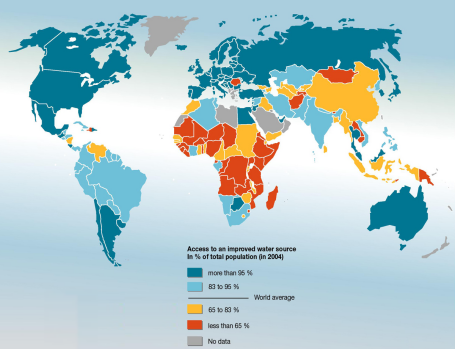
According to the definition of UNICEF and WHO: piped water into dwelling, Public tap or standpipe, Tubewell/borehole, Protected dug well, Protected spring, Rainwater collection.
Sources: World Health Organization (WHO) and United Nations Children's Fund (UNICEF) Meeting the MDG Drinking Water and Sanitation Target: The Urban and Rural Challenge of The Decade, Geneva (WHO) and New York (UNICEF), 2006
Sources: World Health Organization (WHO) and United Nations Children's Fund (UNICEF) Meeting the MDG Drinking Water and Sanitation Target: The Urban and Rural Challenge of The Decade, Geneva (WHO) and New York (UNICEF), 2006
Fresh thinking also means finding practical, appropriate solutions to ensure the reliable and equitable supply of water. Some of these solutions are simple and cheap. Rainwater harvesting, for instance, could help up to 2 billion people in Asia alone. End-of-pipe water purification and public health education about basic hygiene practices would go a long way towards alleviating the global disease burden caused by dirty water.
References:
1 WHO/UNICEF Joint Monitoring Programme for Water Supply & Sanitiation. Progress on sanitation and drinking-water:2010 update.
Geneva, World Health Organization, 2010.
2 WHO: http://www.who.int/docstore/water_sanitation_health/vector/water_resources.htm Accessed 6/23/10.
3 http://www.worldwatercouncil.
4 www.csdw.org
1 WHO/UNICEF Joint Monitoring Programme for Water Supply & Sanitiation. Progress on sanitation and drinking-water:2010 update.
Geneva, World Health Organization, 2010.
2 WHO: http://www.who.int/docstore/water_sanitation_health/vector/water_resources.htm Accessed 6/23/10.
3 http://www.worldwatercouncil.
4 www.csdw.org
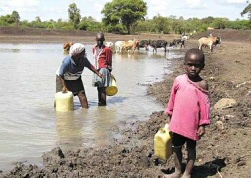


Water is the most critical resource issue of our lifetime and our children’s lifetime.
The health of our waters is the principal measure of how we live on the land.
The health of our waters is the principal measure of how we live on the land.

- Luna Leopold
Purify.org.uk
2a Hinde Street
London W1U 2BA
United Kingdom
2a Hinde Street
London W1U 2BA
United Kingdom
Tel:020 7487 4206
Email:enquiries@purify.org.uk
Email:enquiries@purify.org.uk
